Cultural identity
Armenian Christians
Armenian Christian communities have a distinctive language, worship and cultural heritage, with longstanding centres across the Middle East and a wider diaspora. The Armenian Apostolic Church belongs to the Oriental Orthodox family, while Armenian Catholic and Evangelical churches are separate traditions; Armenian identity therefore should not be reduced to a single church affiliation.

These communities are connected by church tradition, language, culture, homeland or migration. The labels overlap: a Palestinian Christian may also be an Israeli citizen and belong to an Orthodox, Catholic or Protestant church. This is an introduction to that diversity, not a complete list or a set of separate population groups.
Historical roots
Armenia’s royal adoption of Christianity in the early fourth century is closely associated with Gregory the Illuminator. In the early fifth century, Mesrop Mashtots devised an Armenian alphabet, enabling a major translation movement that included the Bible. Armenian Christian culture subsequently developed its own literature and worship, rather than simply reproducing the neighbouring Greek or Syriac traditions.
CNEWA · The Armenian Apostolic Church ↗Saint John Armenian Church · The Armenian alphabet ↗
Worship, languages and traditions
The Armenian Divine Liturgy is commonly called the Badarak and preserves Classical Armenian, known as Grabar. This literary language differs from modern spoken Armenian. The Apostolic Church’s catholicosates of Etchmiadzin and Cilicia share the same communion, while Armenian Catholic and Evangelical communities have distinct church affiliations; a shared language does not imply identical church government.
Armenian Diocese of the UK and Ireland · Worship ↗CNEWA · The Armenian Apostolic Church ↗World Council of Churches · Lebanon ↗CNEWA · The Catholic Eastern Churches ↗
Regional life and diaspora
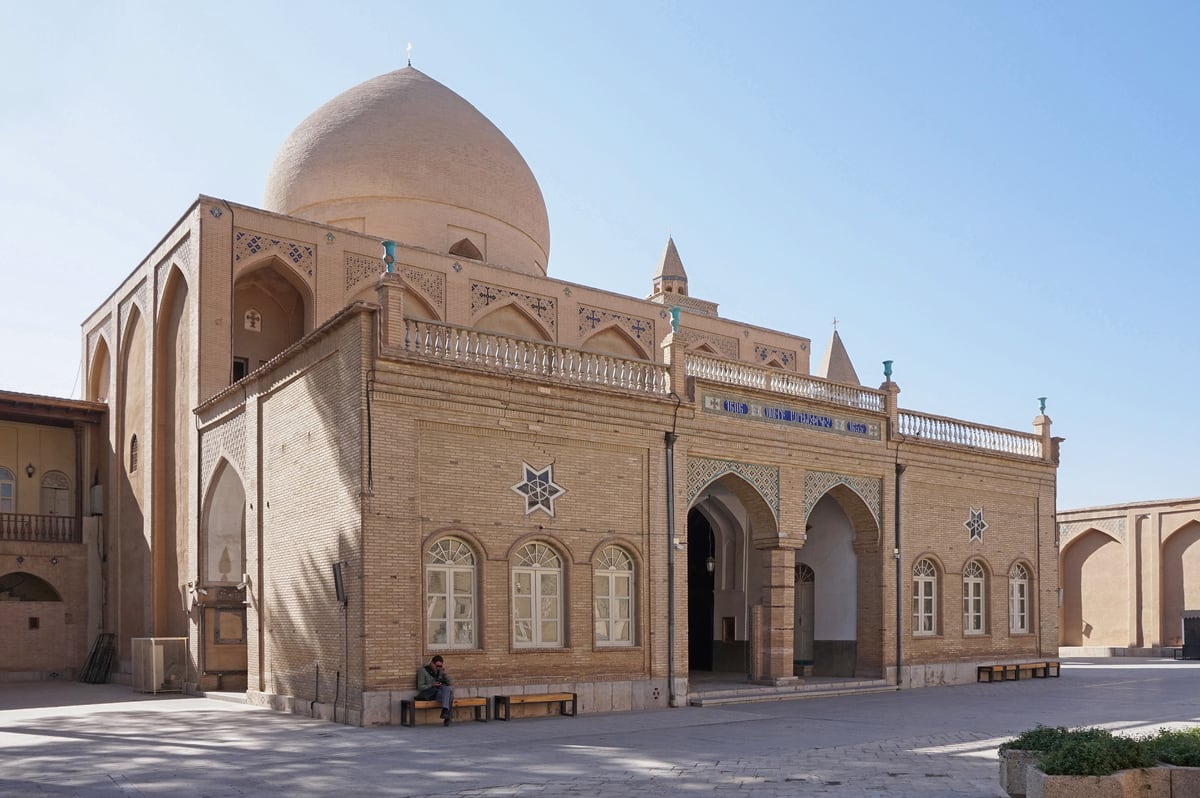
Armenian Christianity has longstanding centres in Jerusalem and in the cities of the eastern Mediterranean. The Cilician catholicosate is based at Antelias in Lebanon, while Iran’s New Julfa preserves churches built after the forced relocation of Armenians in 1604. Vank Cathedral reflects that encounter between Armenian religious life and the artistic setting of Safavid Isfahan.
World Council of Churches · Holy See of Cilicia ↗British Institute of Persian Studies · Vank Cathedral ↗Encyclopaedia Iranica · Julfa in the Safavid period ↗
Sources
- World Council of Churches · Holy See of Cilicia ↗
- World Council of Churches · Lebanon ↗
- CNEWA · The Catholic Eastern Churches ↗
- CNEWA · The Armenian Apostolic Church ↗
- Saint John Armenian Church · The Armenian alphabet ↗
- Armenian Diocese of the UK and Ireland · Worship ↗
- British Institute of Persian Studies · Vank Cathedral ↗
- Encyclopaedia Iranica · Julfa in the Safavid period ↗