Cultural identity
Palestinian Christians
Palestinian Christians belong to several churches, including Greek Orthodox, Latin and Eastern Catholic, Anglican and Lutheran communities, with congregations in Jerusalem, the West Bank and beyond. “Palestinian” describes a national and cultural identity rather than a denomination; some Palestinian Christians are also Israeli citizens, and family and church connections extend across borders.
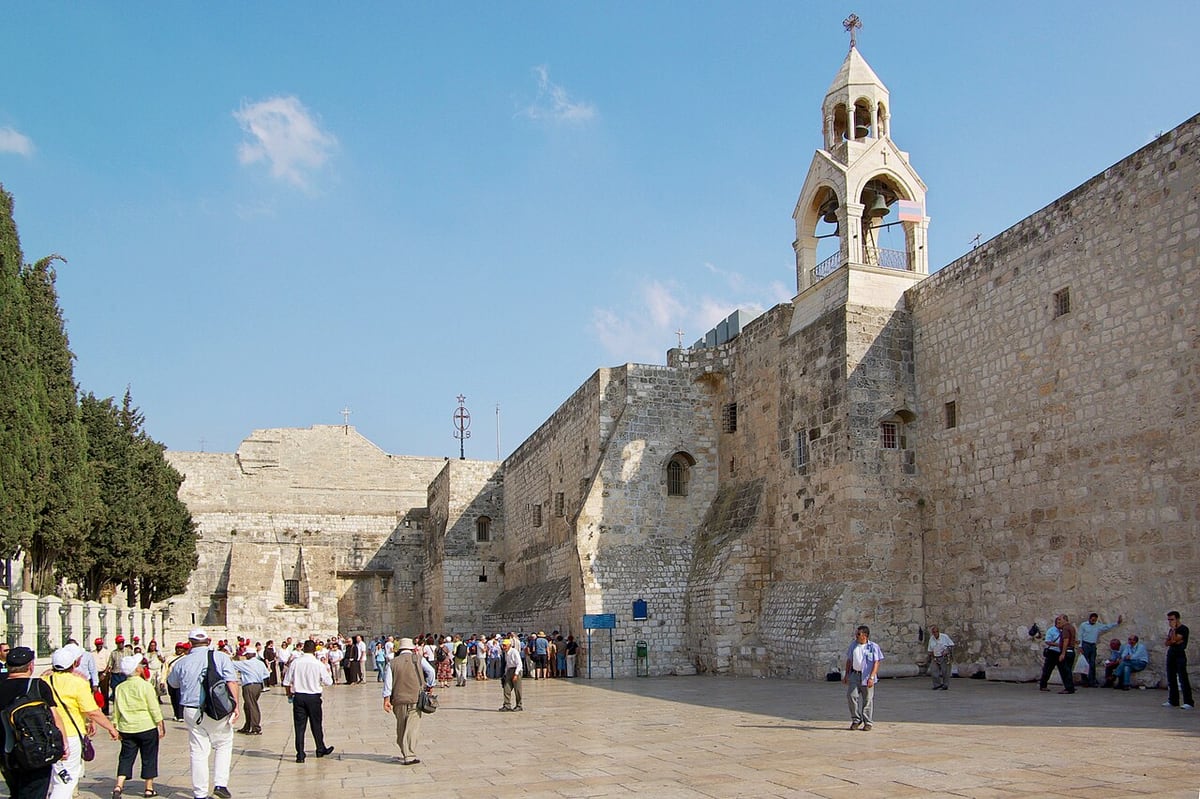

These communities are connected by church tradition, language, culture, homeland or migration. The labels overlap: a Palestinian Christian may also be an Israeli citizen and belong to an Orthodox, Catholic or Protestant church. This is an introduction to that diversity, not a complete list or a set of separate population groups.
Historical roots
The region’s Christian history is visible in Bethlehem’s Church of the Nativity: its first church was completed in 339 and the present basilica largely reflects sixth-century rebuilding. That long religious history should not be confused with the age of modern national identities; Palestinian Lutheran institutions, for example, developed from nineteenth-century missions and later became locally led churches.
UNESCO · Nativity church history ↗ELCJHL · Palestinian Lutheran history ↗
Worship, languages and traditions
A shared national identity does not imply a shared liturgy or church authority. At the Church of the Nativity, Greek Orthodox, Armenian Apostolic and Franciscan Catholic communities share responsibilities within the same complex; elsewhere, Palestinian Christians worship in their own parish churches, with Orthodox, Catholic, Anglican and Lutheran affiliations that connect them to wider church families.
UNESCO · Nativity shared custody ↗ELCJHL · Local church communities ↗Anglican Communion · Jerusalem and Middle East ↗
Regional life and diaspora
Christian institutions contribute to education as well as worship: Bethlehem University, founded in 1973 in the Lasallian tradition, serves both Christian and Muslim students. Family displacement also shaped church geography: the Lutheran congregations in Ramallah and Amman were established to serve refugee families, showing how local parish life and connections across borders became closely intertwined.
Bethlehem University · Foundation and shared education ↗ELCJHL · Refugee-linked congregations ↗